
by Charles Woolfson Sensei
Godan
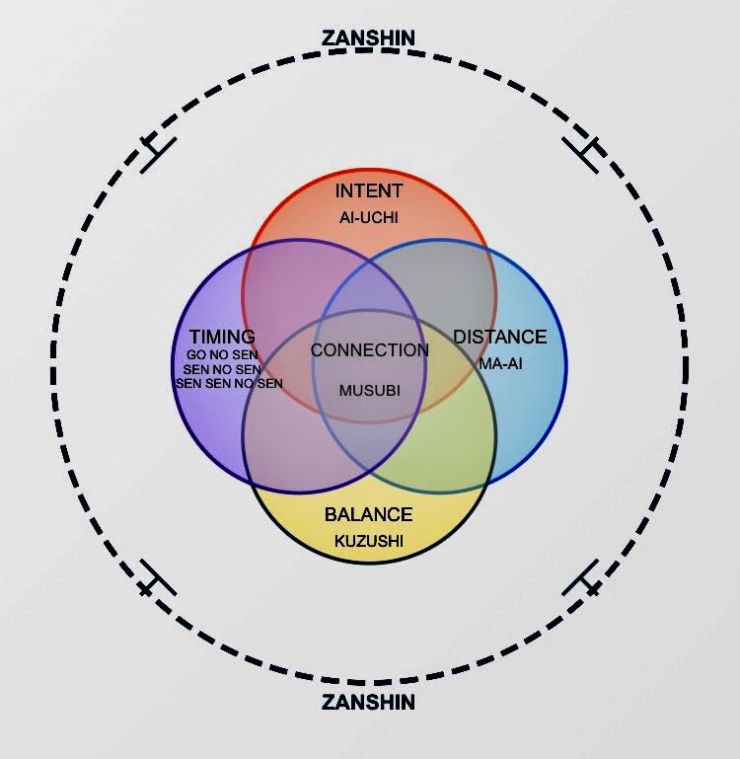
- These principles are understood both through sword and empty hand.
- Connection - ‘musubi’ - is the beating heart of aikido. It is ever-changing in feeling. Learn to relax. Without relaxed ‘musubi’, the ‘limbs’ of intent, distance, timing, balance and awareness cannot be connected with our centre (hara). Cultivate an integrated unity of mind, spirit and body. This comes only with long practice.
- ‘Intent’ - ai-uchi - is mutual strike. This is the decisive moment of conflict when superior attitude and spirit prevails. We need to learn to read our opponent’s intent, telegraphed in the smallest movement of body and mind.
- ‘Distance’ - ma-ai - is relative, but always one moves closer and closer. Search for the ‘opening’ or vulnerability (suki) in every technique. Be prepared to enter ‘magnificently’ with irimi (William Coyle sensei).
- ‘Timing’. There are three ‘timings’ of go no sen, sen no sen and sen sen no sen. Do not practice ‘waiting’ aikido. Equally, do not ‘snatch’ the opponent’s attack. Change the ‘rhythm’ of the technique to neutralize the attack.
- ‘Balance’ is the blending of our own axis and that of the opponent. Therein, lies the spiral movement - upwards or downwards. Change the level of attack, then the opponent falls ‘by themselves’ into the empty space formed by kuzushi. Kuden: “Enter, become one, create a pathway, don’t ‘throw’” (Kayla Feder sensei).
- Awareness - ‘zanshin’ - is our surrounding energy body which we must protect, as we do with the physical body. Our gaze is soft, wide and unfocussed. Our posture is ‘no-posture’ from which endless possibilities arise.
Kuden:
Know the dark side, but do not dwell there.
Seek the light, and exercise compassion
It may take some time
Meanwhile, breathe in and breathe out
In the end, that is all there is.